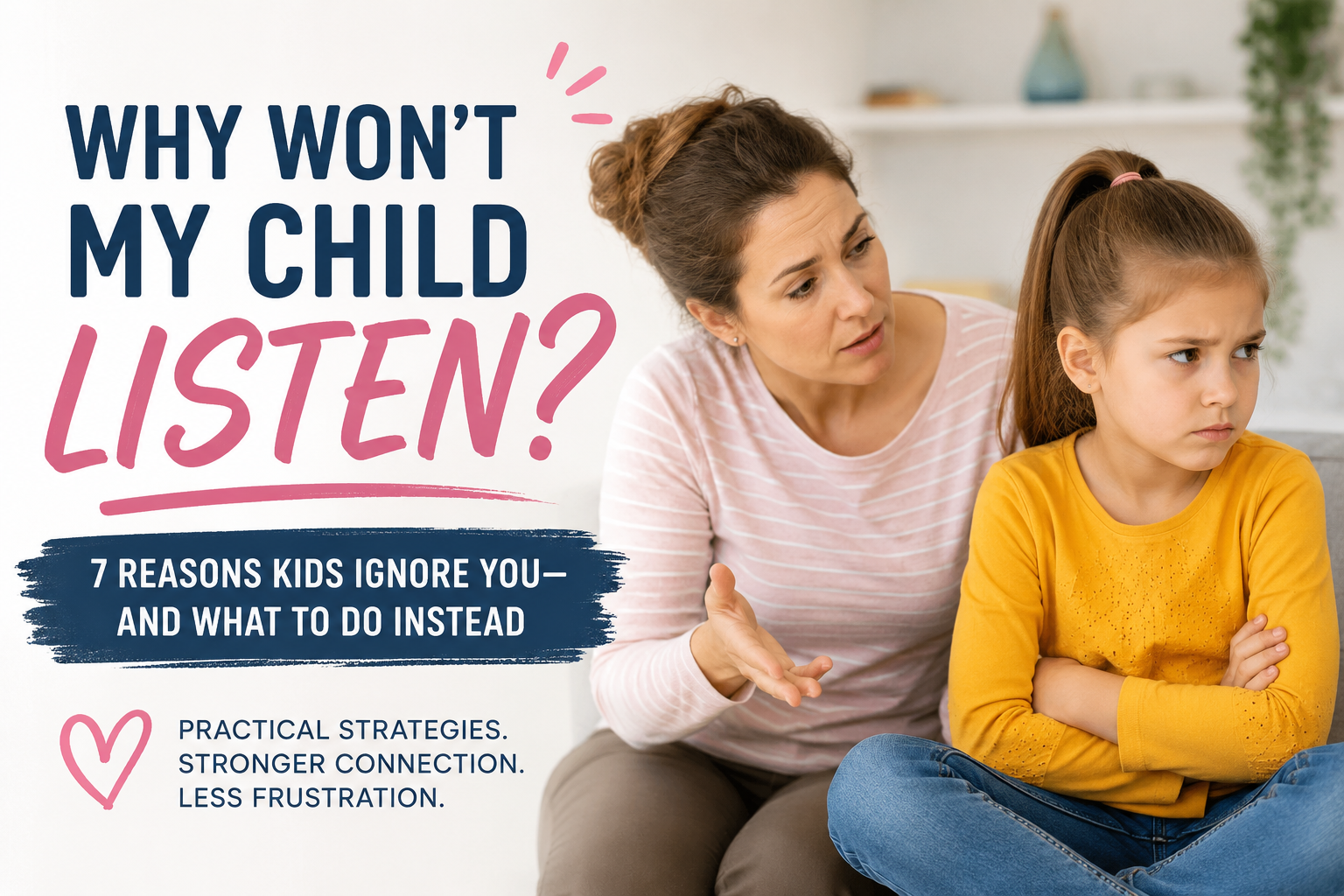
Why My Child Won’t Listen
If you’ve ever found yourself saying,“My child hears me… so why won’t they listen?”you’re not alone.
This question comes up again and again in my work with moms — especially moms raising strong-willed kids. And it’s often followed by worry, frustration, or quiet self-doubt.
Here’s the reassuring truth most moms aren’t told:When kids don’t listen, don’t just assume it’s about defiance or disrespect.
More often, it’s about what their brain and nervous system can handle in that moment.
Listening Is Not a Character Issue
As adults, we tend to assume listening is a choice. If someone doesn’t listen, we assume they’re being stubborn or dismissive.
Children are different.
A child can want to listen and still be unable to. When emotions are high, the part of the brain responsible for reasoning, impulse control, and cooperation simply isn’t fully online.
Strong feelings — frustration, disappointment, excitement, fatigue, hunger — all reduce a child’s capacity to process instructions.
This is especially true for strong-willed kids.
Strong-Willed Kids Feel First, Think Second
Strong-willed children experience the world intensely. They feel deeply, react quickly, and often struggle to slow down once emotions rise.
That doesn’t make them difficult.It makes them sensitive, perceptive, and driven.
But it also means that when they’re overwhelmed, listening becomes hard — even when your request is reasonable and familiar.
When a child’s nervous system shifts into stress or defense mode, words don’t land the way we expect them to.
They aren’t ignoring you.They’re overloaded.
Why Repeating Yourself Usually Backfires
When kids don’t listen, most moms naturally do one of three things:
Repeat themselves
Speak faster
Raise their voice
That response makes sense. You’re trying to regain control and get things moving.
But here’s what often happens instead.
Repetition without regulation feels like pressure to a child’s nervous system. Pressure increases stress. Stress increases resistance.
So the child doesn’t become more cooperative — they become more defensive.
What your child hears isn’t your instruction.They hear urgency.
And urgency shuts listening down.
Emotional Safety Is the Gateway to Listening
Children listen best when they feel emotionally safe — not permissive, not in charge, but secure.
Emotional safety doesn’t mean there are no rules.It means rules are delivered with calm authority instead of emotional intensity.
Emotional safety sounds like:
A steady, regulated tone
Fewer words, not more
Confidence without force
Clear expectations without threats
When children feel safe, their brain stays open.When the brain stays open, learning and cooperation are possible.
Why “Being Calm” Feels So Hard
Many moms tell me,“I know I should stay calm — but I just can’t sometimes.”
That’s not a personal failure. It’s biology.
When your child doesn’t listen, your own nervous system can become activated. Your body reads the situation as urgent, and your stress response kicks in.
That’s why yelling can happen so quickly — even for thoughtful, intentional moms.
This isn’t about willpower.It’s about regulation.
The good news? Regulation can be learned and practiced — slowly and imperfectly.
A Simple Shift That Helps Kids Listen
Instead of repeating yourself, try this small but powerful shift:
Pause for a few seconds
Lower your voice
Move physically closer
Use fewer words
For example, instead of:
“I’ve asked you three times to put your shoes on. Why aren’t you listening?”
Try:
“I’m here. Shoes on.”
This works because:
Proximity increases connection
Fewer words reduce overwhelm
Calm tone signals safety
Confidence signals leadership
You’re not pleading.You’re leading.
What If They Still Don’t Listen?
Listening is a skill that develops over time. One calm moment won’t fix everything — and that’s okay.
Progress looks like:
Slightly faster recovery
Less escalation
Fewer power struggles
More moments of cooperation
You’re laying a foundation, not flipping a switch.
If You’re Feeling Discouraged
If listening feels like adaily battle, please hear this clearly:
Your child is not broken.And you are not failing.
Strong-willed children need calm, consistent leadership — not louder voices or harsher consequences.
When moms learn how to regulate themselves first, children feel safer — and listening improves naturally.
Thereisa way to lose the loud without losing your authority.And it begins with understanding what’s really happeningbeneath the behavior.
Want support without the yelling?I teach these tools slowly and practically in live Zoom classes for moms raising strong-willed kids.You can get on the class schedule here:973-493-6918
View original article and linked resourcesA little support for your next step.
Let’s find an approach that fits your child and your family.